

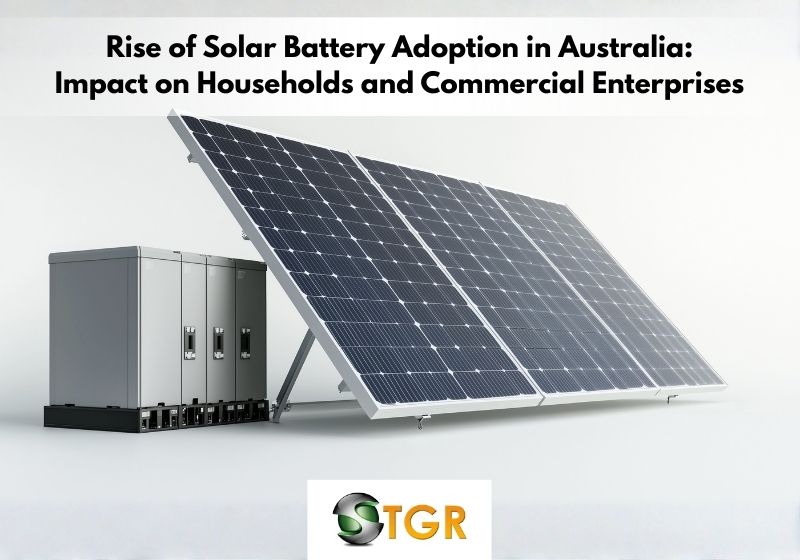
Rise of Solar Battery Adoption in Australia: Impact on Households and Commercial Enterprises
Australia’s energy transition is accelerating at an unprecedented pace. With rooftop solar now
a mainstream technology and battery storage rapidly following, 2025–2026 marks a turning
point in how households and commercial enterprises consume, store, and manage
electricity.
This is not just a renewable energy trend; it is a structural shift in how Australians think about
energy independence, cost control, and grid reliability
Battery adoption is scaling.
Commercial storage is industrialising. The next 3–5 years will likely determine how fast Australia transitions from a solar-heavy grid to a storage-enabled renewable system. For households, batteries mean independence and cost control.
For businesses, they mean resilience and competitive advantage.
For the grid, they mean stability in a renewable future.
Australia’s Renewable Momentum in 2025–26
Australia added approximately 7 GW of renewable energy capacity in 2025, continuing its strong momentum after record growth in 2024. In the final quarter of 2025, renewables supplied nearly 50% of electricity across the National Electricity Market, with an annual average of 42.9% for the full year. Behind these numbers is a clear reality:- Rooftop solar is widespread.
- Utility-scale renewables are expanding.
- Battery storage, especially residential, is scaling rapidly
Where Australia Stands on Solar & Batteries
According to industry reporting:- More than 4 million Australian households and businesses have rooftop solar
- However, only about 320,000 systems currently include battery storage (roughly 1 in 12 solar users)
Impact on Households
1. Greater Energy Independence With falling feed-in tariffs and rising retail electricity prices, households are prioritising self-consumption. A battery allows families to:- Store excess daytime solar
- Use stored energy at night
- Reduce grid dependence
- Maintain power during outages (in many system
- Avoid peak pricing
- Participate in virtual power plant programs
- Optimise time-of-use tariffs
Impact on Commercial Enterprises
While residential uptake is accelerating, commercial battery storage is also gaining traction. 1. Demand Charge Reduction Commercial and industrial businesses face high peak demand charges. Battery systems help:- Smooth load curves
- Avoid peak penalties
- Lower operational electricity costs
- Lower Scope 2 emissions
- More predictable renewable sourcing
- Greater resilience in operations
- Provide grid services
- Participate in frequency control markets
- Generate additional revenue streams
Why Adoption Is Accelerating Now
Several structural drivers are aligning- Falling solar feed-in tariffs
- Rising retail electricity prices
- Government-supported battery programs
- Rapid growth in renewable generation
- Increasing grid volatility and blackout concerns
What This Means for the Future
Australia is entering the “storage decade.” Rooftop solar adoption is mature.Battery adoption is scaling.
Commercial storage is industrialising. The next 3–5 years will likely determine how fast Australia transitions from a solar-heavy grid to a storage-enabled renewable system. For households, batteries mean independence and cost control.
For businesses, they mean resilience and competitive advantage.
For the grid, they mean stability in a renewable future.